Camping
Building a Tarp Shelter for Rain and Wind
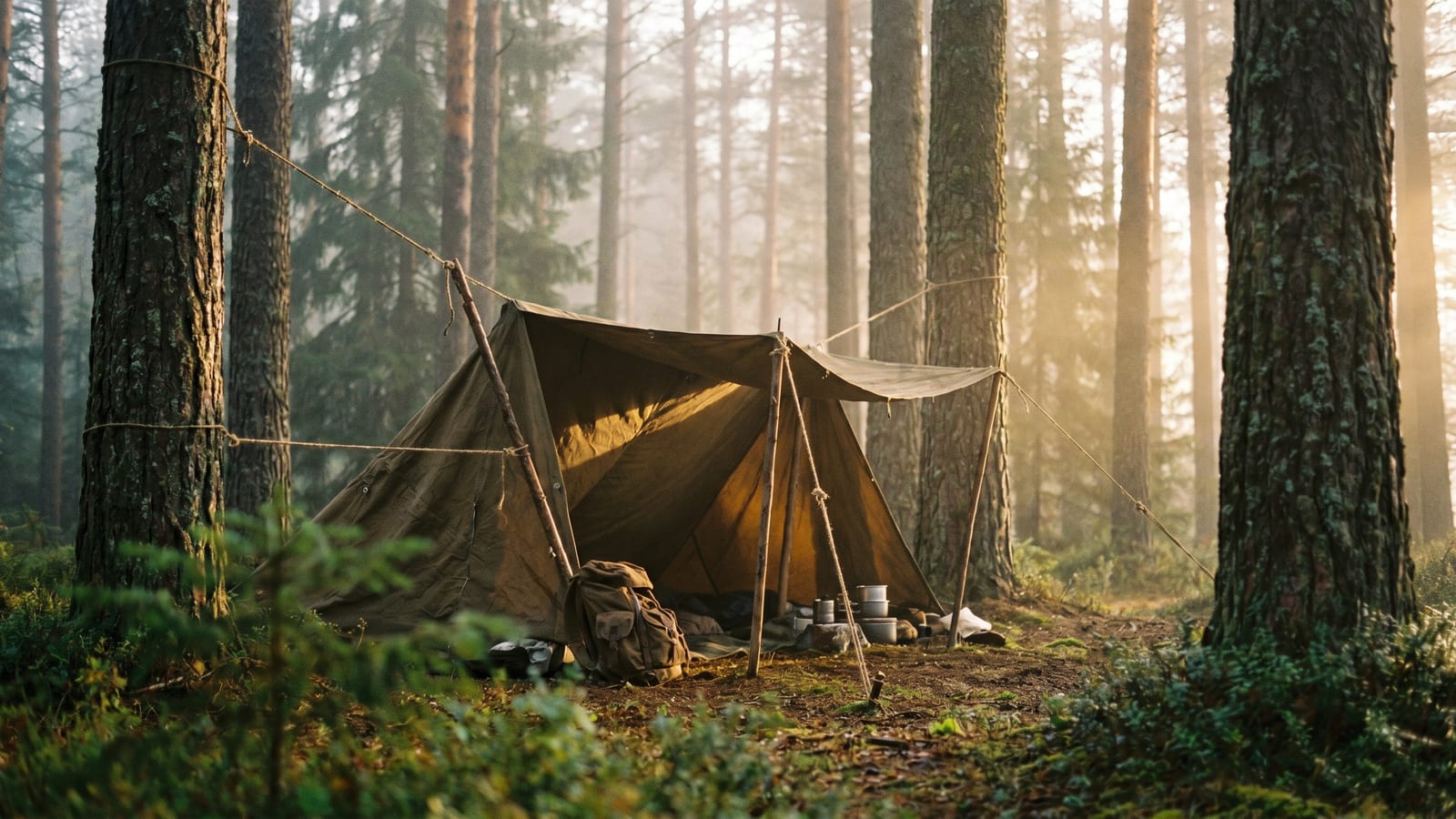
For building tarp shelter rain wind setups, most people assume tents are the safer bet. They’re not. A well-pitched tarp sheds driving rain, deflects wind, and adapts to changing conditions in ways a tent never can. A tent has one configuration. A tarp has a dozen.
This guide covers everything you need to get a tarp up fast and have it stay up when conditions get ugly: materials, knots, reading the wind, the configurations that actually work, and what to do when there are no trees in sight.
Why Tarp Shelters Excel in Bad Weather
The big advantage of a tarp over a tent is adaptability. When the wind shifts or the rain starts coming in sideways, you can drop a side lower, add a guyline, or completely reconfigure in minutes. You can also pitch it much lower to the ground than a tent, which is the single most effective thing you can do in high wind.
Tents have walls. Those walls catch wind. In sustained gusts, that becomes a structural problem. A tarp pitched low with a closed end into the wind presents a much smaller profile. It deflects rather than resists.
One well-chosen tarp configuration handles both rain and wind simultaneously. The closed-end A-frame, which we’ll cover in detail, is designed for exactly that.
What Tarp Works Best for Rain and Wind?
Material is the first decision. Three options dominate:
Polyethylene (the blue or brown tarps at hardware stores) is heavy, loud in the wind, and prone to cracking in cold. It’s fine for base camp or car camping where weight isn’t a factor.
Silnylon is the backpacking sweet spot. Lightweight, packable, and waterproof. It does stretch when wet, which means your ridgeline tension changes overnight. Adjust for this by using a taut-line hitch instead of fixed knots. A quality silnylon tarp holds up through years of hard use.
DCF (Dyneema Composite Fabric) doesn’t stretch, doesn’t absorb water, and sheds weight aggressively. It also costs three times more than silnylon. Unless you’re counting grams, the premium is hard to justify.
Size matters. For solo camping, 8x10 ft is the minimum that gives you enough coverage to keep your sleeping setup and gear dry. Two people need at least 10x12 ft, ideally 11x14 ft.
Grommet density is the spec that separates a usable tarp from a frustrating one. Budget poly tarps have grommets only at corners. Better tarps add midpoint grommets along each edge, which opens up more configuration options. Count the attachment points before you buy.
Recommendation: A silnylon 8x10 handles the needs of most readers here. It’s light enough to backpack, tough enough to last, and covers every configuration in this guide.
The Knots You Actually Need
You don’t need to know ten knots. You need three.
Bowline: Creates a loop that holds its shape under load. Use it to tie your ridgeline to a tree or anchor point. Easy to untie even after it’s been tensioned. This is your go-to for any end where you want zero movement.
Taut-line hitch: An adjustable loop you can slide to increase or release tension. Use it at the opposite end of your ridgeline from the bowline, and on any guyline stake. This is what lets you re-tension your tarp at 2am when silnylon has stretched and water is pooling.
Prusik knot: A friction hitch that grips a ridgeline and stays put until you slide it deliberately. Use it to attach the tarp’s ridge attachment points to your ridgeline. It lets you position the tarp exactly where you want it and shift it without untying anything.
Learn these three on your couch before your first trip. Ten minutes of practice is enough.
Reading the Wind Before You Pitch
Before you touch your tarp, spend two minutes observing. Look at the trees: which way are the branches pushed? Check nearby water for ripples. Watch how clouds are tracking overhead. All three will converge on the same answer.
Once you know where the wind is coming from, the rule is simple: the closed or solid side of your shelter faces into the wind. Never set up with an open end pointing toward the prevailing wind direction.
The A-frame beats the lean-to in anything beyond a light breeze. The reason is simple: the A-frame’s peaked ridge deflects wind up and over. A lean-to’s open face acts like a scoop. At modest wind speeds that scoop just makes things drafty. At higher speeds it starts applying serious load to your stake system.
The Ridgeline Setup: Your Foundation
The ridgeline is everything. Get this right and the rest of your setup is just staking and tensioning.
- Find two trees roughly 10 to 13 feet apart, depending on your tarp length.
- Tie a bowline around the first tree at chest height, leaving 18 inches of tail.
- Run your ridgeline cord (use amsteel or zing-it, not thin paracord) across to the second tree.
- Wrap the cord around the second tree and finish with a taut-line hitch. Pull it taut enough that the line has minimal sag, but don’t over-crank it. A slight curve is fine.
- Drape the tarp over the ridgeline and attach the ridge points using prusik knots. Slide them to center the tarp.
- Stake out the four corners, pulling outward and downward. Each corner should be under tension but not overtensioned.
In wind: drop the ridgeline height to chest or even stomach level. A lower pitch means a smaller wind profile and shorter, more effective guylines. It feels cramped until you’re actually inside, dry and warm.
No trees: two trekking poles work well. Stake the tarp’s ridge-end grommets to the pole tips and guy the poles out at 45 degrees to prevent them from kicking inward.
The Closed-End A-Frame: Best All-Around for Rain and Wind
This is the configuration you want for serious rain or any night where conditions are genuinely uncertain. It’s an A-frame with one end sealed to the ground.
- Set up your ridgeline as described above.
- Stake the windward end of the tarp flat to the ground, pulling all corner and edge grommets tight to the earth. This end is now sealed.
- At the leeward end, use a single trekking pole inserted under the tarp at the center ridge point to raise the entry to a workable height.
- Stake the leeward corners outward at a low angle, roughly 30 to 45 degrees from vertical.
- Add a guyline to the pole tip and stake it out ahead of the open end for stability.
The key with drainage: your corner stakes need to be slightly lower than the center of the tarp panels. Water runs downhill. If your corners are high or the tarp is sagging at center, you’ll wake up to a puddle directly above your face. Pull corners down and out, and the water routes to the edges and off.
For exposed sites, lower the trekking pole by 6 to 8 inches and widen the stake angles. Less height, more ground coverage. You’ll have to crouch to enter, but you’ll stay dry.
The Lean-To: When It Works and When It Doesn’t
The lean-to is the fastest pitch. Tie one edge high on your ridgeline and stake the opposite edge to the ground. Done in four minutes. Use it for a cooking shelter on a calm evening, keeping gear dry at base camp, or a quick break during a day hike.
The problem is that open face. Anything beyond a light breeze pushes under the tarp and either lifts it off your stakes or dumps rain into your living space. Use the lean-to only when you’ve confirmed the weather is genuinely mild, and orient the open face away from the prevailing wind without question.
Wind-Only Modifications: Lower, Wider, Tighter
When wind picks up mid-trip and you’re already pitched, three adjustments help:
First, drop your pole height. Every inch lower reduces wind load meaningfully. This is the most effective single change you can make.
Second, extend your guylines and re-stake them at a lower angle. Short, steep guylines allow the tarp to flap. Long, shallow guylines pull the sidewalls taut and kill the sail effect.
Third, at either end of your A-frame: lash a stuff sack filled with a rock or dirt to the ridgeline just inside the opening and let it hang at center. It adds downward tension to the peak and reduces flapping. Not elegant, but effective.
No-Trees Scenario: Staking Without Natural Anchors
Open meadows, alpine tundra, beach campsites, and desert flats all present the same problem: nothing to tie to. Here are your options:
Trekking poles as endpoints: already covered above. Two poles, guyed wide, handle most conditions.
Deadman anchor: bury a stuff sack packed with soil, snow, or gravel. Attach your guyline to it before burial. A foot of depth in firm soil holds more than most tent stakes. In snow, a buried water bottle works well.
Vehicle anchor: for car camping on exposed ground, running a ridgeline from a roof rack or hitch to a pole or stake gives you one reliable high point.
Lashed pole to a fixed structure: a fence post, signpost, or sturdy bush branch can substitute for a tree. Always test it before trusting it with your shelter overnight.
Common Mistakes and How to Avoid Them
Pitching too high. Wind gets under a high tarp and becomes a lever. Lower is almost always better.
No drainage angle. If your tarp panels aren’t sloped, water ponds in the center. Stake corners lower than the center and ensure there’s visible tension pulling water toward the edges.
Using thin paracord for the ridgeline. Paracord stretches, and the ridgeline is under constant load. Amsteel or zing-it holds tension without creep and doesn’t absorb water. A 15-foot length is cheap and weighs almost nothing.
Skipping the taut-line hitch. Fixed knots on a silnylon ridgeline will loosen as the material stretches. The taut-line hitch lets you re-tension in 30 seconds without untying anything.
Quick-Reference Configuration Guide
| Configuration | Best For | Wind Rating | Skill Level |
|---|---|---|---|
| A-frame ridgeline | General use, mild to moderate weather | Moderate | Beginner |
| Closed-end A-frame | Rain, wind-driven rain, exposed sites | High | Intermediate |
| Lean-to | Fair weather, cooking shelter, gear coverage | Low (light breeze only) | Beginner |
| No-pole stake setup | Minimalist ground sheet or low rain cover | Low to moderate | Intermediate |
The closed-end A-frame is where most people should spend their practice time. Once you can pitch it in ten minutes in daylight, you can pitch it in twenty minutes in the dark in the rain, which is the scenario that actually matters.