Camping
Hammock Underquilts vs Sleeping Pads - Which Is Warmer?
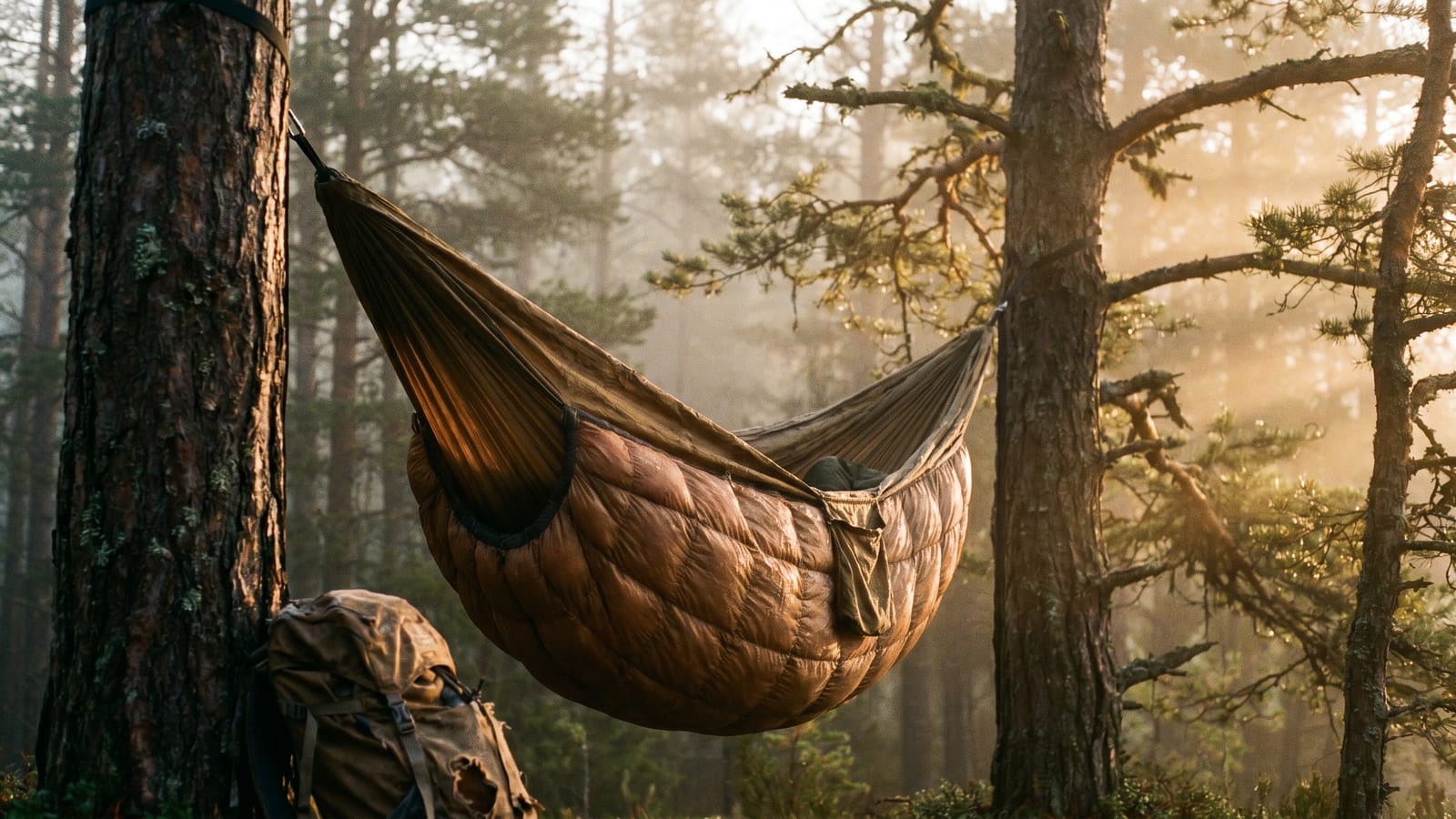
Hanging between two trees is one of the best ways to sleep outdoors. No rocks, no roots, no damp ground. But hammock camping comes with a thermal problem that surprises most beginners: when you are comparing hammock underquilts vs pads, the answer matters more than you think, and the fix is not obvious.
The issue is compression. When you lie on a sleeping pad, your body weight crushes the insulation underneath. On the ground, that works fine because the earth stops the compression. In a hammock, your body sags into the fabric and there is nothing underneath to stop the pad from flattening out. A pad rated R-value 4 can lose half its warmth when your full weight presses it against a taut hammock floor.
That is where underquilts come in. They hang underneath the hammock, suspended the same way the hammock is, so nothing compresses the insulation. No flattened down, no cold spots. The trade-off is cost and versatility.
Here is the full breakdown.
The Real Problem with Sleeping in a Hammock
Most people approach hammock insulation the same way they approach ground sleeping: stack a sleeping pad inside and call it done. That works in summer. Below about 50 degrees Fahrenheit, it starts falling apart.
The physics are straightforward. Your body creates heat. That heat escapes through any gap between you and the surrounding air. A sleeping bag traps warm air next to your body. A sleeping pad stops heat from bleeding into the ground beneath you. On the ground, that system works.
In a hammock, you are surrounded by air on all sides except where the hammock fabric touches you. The open underside means cold air circulates underneath you constantly. A sleeping pad tries to stop that, but it sits inside the hammock where your body weight flattens it against the hammock walls. The edges of the pad end up pressed against your sides rather than underneath you. Heat escapes through those gaps.
An underquilt sidesteps this by hanging outside the hammock entirely. The insulation stays uncompressed, your body heat warms the trapped air inside the quilt, and the warmth stays put.
Sleeping Pads in a Hammock – What Actually Happens
You can absolutely use a sleeping pad in a hammock. People do it. But here is what you are signing up for.
Pads work reasonably well above roughly 50°F if you have a decent R-value. An R-value of 3 to 4 will get you through most three-season hammock camping without major complaints. The problems compound as the temperature drops.
The biggest issue is slippage. You lie down, you shift in your sleep, and the pad slides toward the center of the hammock. Within a few hours, your legs or shoulders are sitting directly on the hammock fabric with nothing between you and the cold. Some people cut notches or “wings” in their pads to wrap around the hammock ends. Others use elastic straps or non-slip fabric. These solutions help but none eliminate the problem entirely.
Pad compression is the second issue. When your body presses the pad against the curved walls of the hammock, the fill compresses at the pressure points. An inflatable pad can lose significant warmth this way. A closed-cell foam pad resists compression better but still loses some insulation where your hips and shoulders bear the most weight.
The third issue is coverage gaps. Hammocks taper at both ends. A standard sleeping pad does not extend fully into those tapers, leaving your feet and head area with less insulation than your torso.
On the upside, pads are versatile. The same pad works in a hammock or on the ground. If you are a beginner who sometimes camps on the ground and sometimes in a hammock, a pad gives you one piece of gear for both situations. Cost is lower, too. A solid closed-cell foam pad runs $30 to $80. An inflatable pad with decent R-value runs $80 to $150.
Underquilts – Insulation That Hangs with You
An underquilt is exactly what it sounds like. It is a quilt, usually filled with down or synthetic insulation, that hangs underneath your hammock attached to the same suspension points as the hammock itself. The quilt hangs freely, creating a warm pocket of air between your body and the outside air.
The key advantage is that nothing compresses the insulation. Your body heat warms the air inside the quilt, and the loft stays intact throughout the night. This makes underquilts significantly more efficient at lower temperatures for a given weight.
Underquilts come in temperature ratings just like sleeping bags. A 20°F rated underquilt will keep you comfortable down to roughly 20 degrees Fahrenheit in a standard hammock setup. Summer underquilts are available in the 40°F range for warm-weather use. That variety means you can match the quilt to the season rather than overbuying warmth you will never use.
The downsides are real. Cost is the biggest barrier. A decent underquilt starts around $100 for synthetic and runs $150 to $300 for quality down. You also need attachment points on your hammock, which most modern hammocks include but some budget options lack. And underquilts do not work on the ground at all. You cannot take one off the hammock and sleep on the ground with it.
Packability is another consideration. Underquilts do not compress as small as sleeping pads because the insulation is suspended rather than compressed. For ultralight backpackers watching every ounce and cubic inch, this matters.
Key Differences – Underquilts vs Pads at a Glance
| Underquilt | Sleeping Pad | |
|---|---|---|
| Warmth efficiency | High – no compression loss | Moderate – compression reduces R-value |
| Weight (comparable warmth) | 12–20 oz for 20°F down | 16–24 oz for equivalent R-value |
| Packability | Moderate – does not compress fully | Good – inflates small, packs tight |
| Cost | $100–$300 | $30–$150 |
| Ground use | No | Yes |
| Setup complexity | Moderate – needs attachment | Simple – just place inside |
| Durability | Good with care | Good, puncture-resistant for foam |
| Best temperature range | All-season | 50°F and above in hammocks |
When to Choose a Sleeping Pad
Pick a pad if you hammock camp mostly in warm weather. Above 50°F, a sleeping pad with R-value 3 or higher will keep you comfortable without any special setup. You can be in and out of your hammock quickly. You do not need to deal with quilt suspension lines.
Pick a pad if you are on a tight budget and need gear that works in multiple contexts. The same pad you use in your hammock works on the ground. That flexibility is worth something if you are not sure yet how much hammock camping you will do.
Pick a pad if you are an occasional hammock user who does not want dedicated gear. If you hammock camp twice a year and ground camp ten times a year, carrying an underquilt that only works in the hammock is hard to justify.
When to Choose an Underquilt
Pick an underquilt if you hammock camp in temperatures below 50°F with any regularity. At that point, the insulation gap in pad-based systems becomes genuinely uncomfortable. An underquilt rated 20°F or 30°F will keep you warm through shoulder seasons and into early winter without requiring you to layer up excessively inside your sleeping bag.
Pick an underquilt if you have made a commitment to hammock camping. If you have a good hammock with suspension points, the underquilt is the right investment. Yes, it costs more upfront. Over a few seasons, the warmth and sleep quality improvement is worth it.
Pick an underquilt if you sleep cold or you sleep on your side. Side sleepers put more pressure on the hip and shoulder areas of a pad, which means more compression and more heat loss. An underquilt eliminates that problem entirely.
The Hybrid Setup – Underquilt + Sleeping Pad
Here is the option most articles skip. You can use both.
A thin foam pad or a lightweight inflatable placed inside the hammock on top of your body works as a bottom layer of insulation. Combined with an underquilt on the outside, you get two layers of warmth. The pad inside also protects the bottom of your hammock from wear and reduces the draft inside the hammock body.
This setup makes sense for shoulder-season camping where you want extra warmth without an expedition-grade underquilt. It also adds redundancy. If your underquilt gets soaked in a rainstorm, the pad inside keeps you warm while the quilt dries. For users transitioning from pad-only setups, this hybrid approach lets you add an underquilt incrementally without going all-in immediately.
The weight penalty is real. You are carrying two pieces of insulation instead of one. For ultralight trips in warmer conditions, it is overkill. For cold-weather hammock camping where warmth is non-negotiable, it is the most reliable system available.
Our Take – What We Recommend
If you hammock camp in summer and fall when temperatures stay above 50°F, a sleeping pad is the sensible choice. A closed-cell foam pad like the Therm-a-Rest Z Lite gives you R-value 2.2, multi-use versatility, and zero setup complexity for under $50. You do not need an underquilt for warm weather.
If you camp below 50°F, or if you hammock camp regularly regardless of season, get an underquilt. A 20°F rated down underquilt from Hammock Gear or Enlightened Equipment runs $200 to $260 but it will outlast multiple seasons of ground pads and keep you warm in conditions where a pad-based setup just cannot get you there. That is the investment case for underquilts and it holds up.
The hybrid approach is the right call for anyone doing shoulder-season hammock camping where temperatures fluctuate. Layer a thin foam pad inside the hammock as a top insulation layer and you have a system that handles 30°F without requiring expedition-grade gear.
The bottom line: pads work for warm weather and beginners. Underquilts are the correct tool for dedicated hammock campers in cooler conditions. Buy the right gear for the temperatures you actually camp in.