Outdoor Skills
Plunge Pool Maintenance: The Complete Guide to Clean, Safe Water
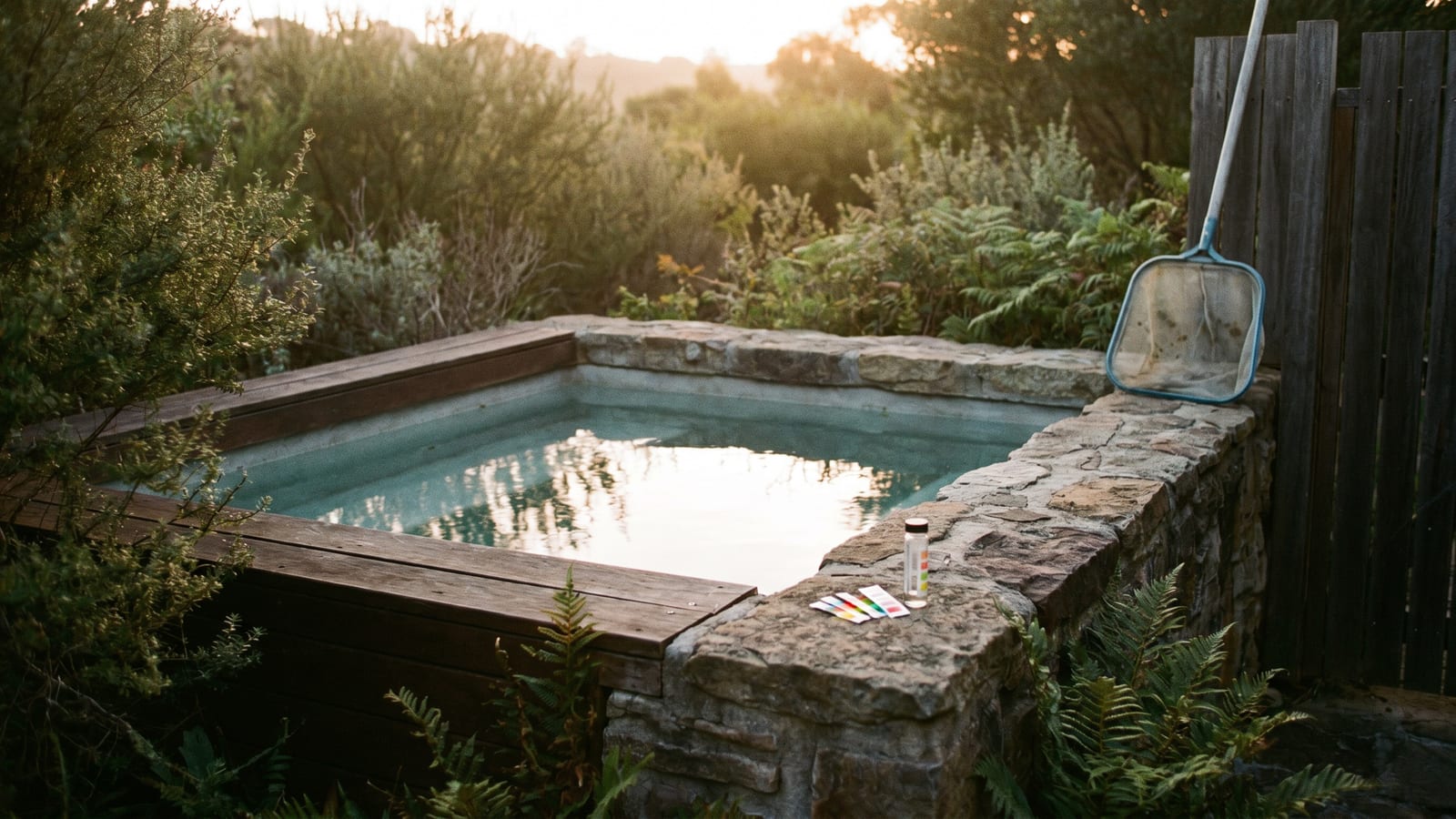
Owning a plunge pool means owning the maintenance alongside it. If you want consistently clean, safe water with no surprises, no weird smells, no slimy walls the first time you use it after a few days off, you need a routine. This guide covers the whole thing: water chemistry, sanitizer options, biofilm removal, material-specific care, and seasonal adjustments. Read the setup section first. That single decision, whether your unit is filtered or unfiltered, determines your entire plunge pool maintenance schedule.
First, Know Your Setup
Plunge pools split into two distinct categories, and they require completely different maintenance approaches.
Traditional plunge pools are small in-ground or above-ground pools, typically 8x8 to 8x12 feet. You use them for occasional cool dips. They get maintained like a small swimming pool, same chemistry, same equipment, same schedules. These sit outdoors or in a dedicated space and are often filled once and kept for a season.
Cold plunge wellness tubs are standalone units holding 100 to 300 gallons. You keep them at 40 to 55 degrees Fahrenheit for post-workout recovery, and you use them daily. These are what most people mean when they talk about plunge pool maintenance online.
The maintenance routines diverge sharply from the start. A filtered wellness tub with a sanitizer can go weeks between water changes. An unfiltered standalone tub needs a full drain and refill every three to seven days if you want safe water. Before anything else, figure out which category you fall into. Everything else in this guide depends on it.
Water Chemistry Basics (and Why Cold Water Changes the Equation)
The target numbers are familiar from pool chemistry: pH between 7.2 and 7.8, alkalinity between 80 and 120 ppm, and sanitizer levels in the range appropriate for whatever product you’re using.
But here is the critical piece most guides skip: cold water fundamentally slows chemical reactions. Below 55 to 60 degrees Fahrenheit, chlorine dissolves more slowly. pH adjustments take longer to register. Total alkalinity shifts don’t show up immediately after you add buffer. Even shock treatments, which work fast in a warm spa, can take six to twelve hours to fully oxidize contamination in water below 50 degrees.
What this means practically: you add chemicals, you wait, then you retest. Do not re-dose based on a reading you took five minutes after adding something. An hour is the minimum wait for small adjustments. For shock treatments or major chemistry corrections, wait overnight before testing again. Rushing this process is how people overshoot their chemical targets and end up with skin irritation or equipment corrosion.
Algae growth is suppressed in cold water, which means your chlorine demand is genuinely lower than it would be in a warm swimming pool. This is good news for chemical costs and skin comfort. It is not an excuse to neglect sanitizer levels, bacteria still grow in cold water, just more slowly.
Cloudiness, odor, slippery surfaces, and color changes in the water are your visual indicators that something is drifting out of range. Treat these as early warnings, not acceptable states.
Choosing Your Sanitizer
Three main options, each with real tradeoffs.
Chlorine is the most familiar and cheapest route. Dose at 1 to 3 ppm. It works, it’s reliable, and every pool store carries it. The downside: chlorine is less stable in cold water and breaks down slower when you want it gone. You also get that mild chlorine odor, which some people find off-putting in a recovery context.
Bromine handles cold water better than chlorine. It stays active at lower temperatures and is gentler on skin. Dose at 3 to 5 ppm. It’s slightly more expensive and can build up used demand that requires periodic shock treatment to reset.
Hydrogen peroxide is popular in the cold plunge community because it breaks down to water and oxygen, no chemical residue, no odor. The catch is concentration.
Drugstore hydrogen peroxide is 3%. Industrial hydrogen peroxide is 30 to 35%, and these are not the same product. The industrial version can cause chemical burns on skin and requires careful handling. “Food-grade” hydrogen peroxide refers to diluted H2O2 suitable for food-contact use, not the concentrated industrial stock. For cold plunge maintenance, stick with 3% drugstore hydrogen peroxide unless you have specific experience handling higher concentrations. Most people do not need the industrial version, and the risk isn’t worth the marginal performance gain.
Ozone and UV systems reduce chemical dependency but are not standalone solutions. They work as add-ons to a primary sanitizer, cutting down how much chemical you need to maintain. They don’t eliminate the need for sanitizer entirely.
Filtered vs. Unfiltered - Your Maintenance Routine Forks Here
This is the decision that determines your entire schedule. There is no universal answer here, only the answer that fits your setup.
Unfiltered systems have no pump, no cartridge, no mechanical filtration. You fill the tub, you use it, you drain it, you refill. For any serious use, drain and refill every three to seven days. There is no workaround. You cannot maintain safe water in an unfiltered system long-term with chemical treatment alone, the contamination load from body oils, sweat, sunscreen, and cosmetics overwhelms the sanitizer capacity of a small volume of standing water.
Filtered systems with a sanitizer and pump are where maintenance gets more manageable. The cartridge filter removes particulate contamination. The sanitizer keeps bacterial growth in check. With this setup, you can stretch water life to eight to twelve weeks under normal use.
Filtered plus ozone or UV extends that window further. With proper care and consistent pump operation, water can last three to six months. This is the lowest-maintenance configuration available, but it requires running the equipment faithfully.
| Setup | Water Change Frequency | Daily Maintenance |
|---|---|---|
| Unfiltered | Every 3-7 days | None, just drain and refill |
| Filtered + sanitizer | Every 2-3 months | Run pump 2-4 hours/day, test weekly |
| Filtered + ozone/UV | Every 3-6 months | Run pump 2-4 hours/day, test weekly |
Usage frequency affects these timelines in ways time alone does not. One person per day is very different contamination load than four people per day. Sweat, sunscreen, body oils, and cosmetics are the primary drivers of water quality degradation, not calendar days. If you have four people using the tub on a Saturday, test your chemistry the following morning regardless of what day of the week it is.
Your Weekly and Monthly Maintenance Checklist
Weekly - Filtered Systems:
- Test pH and sanitizer levels
- Skim visible debris if the tub is outdoors
- Rinse the cartridge filter if pressure gauge shows elevated readings
- Inspect pump operation - listen for unusual sounds, check that circulation is running
Monthly - Filtered Systems:
- Deep clean the cartridge filter: soak in filter cleaner solution per product instructions, rinse thoroughly
- Brush the walls and floor with a soft-bristle brush to dislodge biofilm before it establishes
- Shock the water if sanitizer levels have dropped or if the water has been heavily used since the last shock
- Inspect pump, seals, and O-rings for signs of wear or leaks
Quarterly:
- Full drain and refill for filtered systems, even if chemistry numbers look acceptable
- Inspect all equipment: pump, chiller connections, seals, and plumbing
- Descale the system if you’re in a hard water area
- Replace the cartridge filter if it shows discoloration, odor, or has been through more than twelve to fifteen cleaning cycles (roughly one to two years of regular use)
Biofilm - What It Is and How to Actually Deal With It
Biofilm is a bacterial colony that adheres to surfaces and plumbing. It is not just dirty water. It is a different problem entirely.
Once biofilm establishes in your plumbing and on your tub surfaces, standard sanitizer doses will not touch it. Chlorine and bromine kill free-floating bacteria in the water column, but biofilm is protected by the matrix it builds on surfaces. You can have perfect sanitizer readings and still have a biofilm problem underneath. The only way to confirm you have a biofilm issue is to physically feel the surfaces: if the walls or floor feel slimy even when your chemistry looks perfect, that is biofilm.
The signs: slimy surfaces even with good chemistry, persistent odor that does not go away after shocking, water that looks fine but feels wrong.
The fix is not adding more chemicals. You drain the tub, use a dedicated pipe or line flush product (follow product instructions, AquaFinesse and non-chlorine shock are common choices), scrub all interior surfaces with an enzymatic cleaner, rinse everything thoroughly, and refill. That is the only way through an established biofilm problem.
Prevention is straightforward: maintain sanitizer levels consistently, run your pump daily, and do not let the tub sit stagnant without circulation. Stagnant water is how biofilm gets established in the first place. If you’re not using the tub for a few days, run the circulation pump for at least two to four hours each day anyway.
Cleaning by Material Type
Acrylic and polymer tubs scratch easily. No abrasive pads, no rough scrubbers. Soft cloth or sponge only. Avoid concentrated hydrogen peroxide, which can cloud or degrade acrylic surfaces over time. Diluted white vinegar or a mild spa-specific cleaner handles routine cleaning.
Cedar and wood tubs look great but require different care. Enzyme-based cleaners only. Chlorine bleach degrades wood fibers and shortens the life of the tub. Dry the exterior between uses to prevent mold and wood rot. The interior gets the enzyme treatment; the exterior gets air-dried.
Stainless steel is the most forgiving material. Rinse it down regularly, avoid steel wool which leaves particles that cause rust spots later, and you’re mostly fine. Occasional wipe-down with a stainless cleaner keeps it looking good.
Fiberglass is similar to acrylic, soft cloths only, mild cleaners, no high concentrations of hydrogen peroxide. Abrasive pads create micro-scratches that collect grime and give biofilm more surface area to attach to.
Troubleshooting Common Problems
Cloudy water - Usually a pH imbalance or a filter that needs cleaning or replacement. Check pH first, adjust if needed, then test sanitizer. If chemistry is in range, examine the filter: rinse it, deep clean it, or replace it if it’s been in service for a long time.
Green or brown tint - Green usually means algae, which is rare in cold water but can happen during warm months or if the tub gets significant sunlight exposure. Brown or rust-colored water typically indicates iron or copper, either from your source water or from corroding equipment. A metal sequestrant product handles source water minerals. If equipment is corroding, address the source of the corrosion.
Slimy surfaces - Biofilm. See the biofilm section above. No amount of extra chlorine fixes this. Drain, flush, scrub, refill.
Odor - Chloramines from insufficient sanitizer or buildup of organic contamination. Shock the water and test. If the smell persists after shocking and chemistry is correct, consider a drain and refill, the odor may be coming from biofilm established below the waterline.
Foamy water - Body oils, lotions, or laundry detergent residue from swimwear. Enzyme treatment followed by a partial drain and fresh water fill handles this. Check that detergent residue is fully rinsed from any items that contact the water.
Seasonal Maintenance Notes
Summer raises ambient temperatures, which warms outdoor water and accelerates bacterial growth. If your cold plunge sits outside, expect to test chemistry more frequently during hot months. Algae becomes a real possibility instead of a theoretical concern. Run the chiller consistently to maintain temperature and suppress biological activity. If the tub is in direct sunlight, consider a UV-resistant cover when not in use, both to block algae-promoting UV light and to reduce evaporative water loss.
Winter presents freezing risk for external plumbing and equipment. If your system has exposed pipes, either winterize the setup or maintain circulation through the coldest nights. Do not let water freeze in the lines. For setups in unheated spaces like garages, be aware that ambient temperatures below 40 degrees can affect the chiller’s ability to maintain target water temperature, even if the unit itself is running.
Spring and fall are the easiest seasons for cold plunge maintenance. Ambient temperatures typically fall in the sweet spot where your chiller works less hard and bacterial growth stays slow. Use these shoulder seasons to catch up on equipment inspection and replace worn components before summer stress or winter freeze risk arrives.
Year-round units with chillers need circulation running every day, even when you’re not using the tub. Minimum two to four hours of pump operation per day prevents stagnation. Stagnant water is the starting point for every serious maintenance problem, biofilm, bacterial blooms, chemical stratification. Run the pump. Every day.
The maintenance routine that works best is the one you’ll actually follow. If you have an unfiltered setup and three to seven day water changes feel like too much friction, consider upgrading to a filtered system. The equipment cost is real, but it changes the maintenance burden from a chore into something manageable in five minutes a day. That consistency is what keeps the water safe and the tub lasting.