Hunting · Gear
Night Vision vs Red Dot for Hog Hunting in the Dark
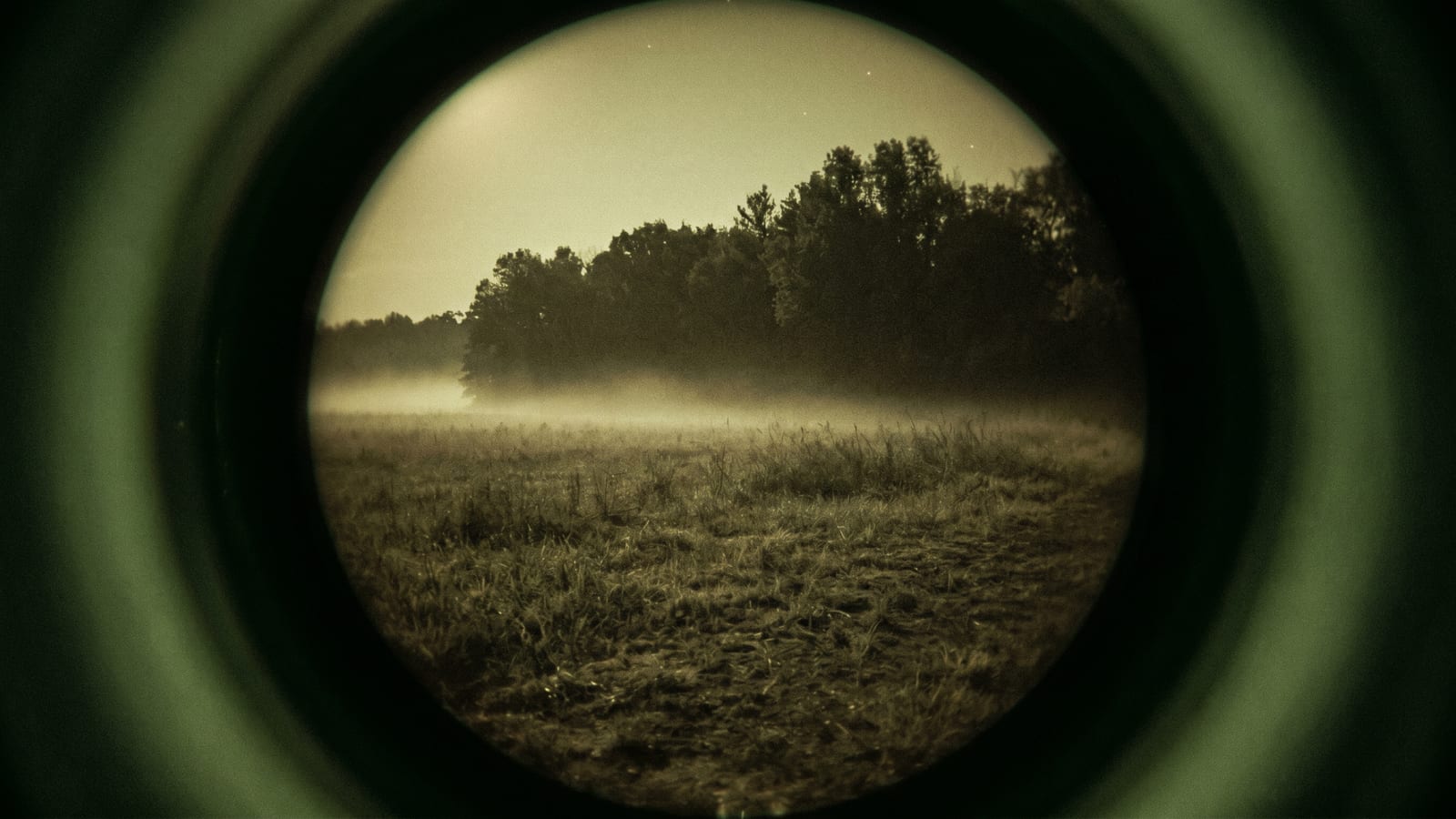
Feral hogs are nocturnal. They move after sunset, feed through the night, and are most active in the couple hours before dawn. If you are serious about controlling hog numbers on your property, you need optics that actually work in the dark - not optics that theoretically work in low light if conditions are perfect.
Night vision and red dot sights are the two most common choices for hog hunters working after hours. They are not interchangeable. The difference between them comes down to one fundamental issue: how each system handles the absence of light.
This guide cuts through the marketing language and gives you what you actually need to make a decision.
How These Two Systems Handle Darkness
A red dot sight is a reflector optic. It projects a small LED-illuminated reticle - a dot, ring, or cross - onto a partially reflective lens. Your eye sees the reticle superimposed on the field of view. The reticle itself works fine in the dark - the LED produces the dot regardless of ambient light. The problem is the target. A red dot tells you where your rifle is pointed, but it does not illuminate what you are pointing at. In daylight or a well-lit food plot, that is not an issue. In total darkness, you can see the glowing dot floating in a black void with no hog visible behind it. Without additional target illumination, the optic is useless.
Night vision works differently. It takes whatever minimal light exists - photons - and amplifies it electronically. The result is a green or grayscale image that lets you see the world as it appears at night. Add an infrared illuminator and you can operate in total darkness with no ambient light at all. That capability is the entire argument for night vision on a hog hunt.
For hog hunting specifically, this is not a subtle difference. You will be in the dark. Real, total, no-moon darkness. A red dot that needs light to function is the wrong tool for that job.
Night Vision - What You Are Actually Getting
Night vision comes in generations. The differences matter for hog hunting.
Gen 1 is the entry level. You can find Gen 1 night vision scopes and clip-ons for a few hundred dollars. They amplify ambient light and work under a clear sky with stars or a quarter moon. They do not work in timber with a closed canopy on a moonless night. Image quality is grainy and the effective range tops out around 75 to 100 yards on a good night. For a landowner putting occasional pressure on hogs near feed stations, Gen 1 might get you by. For regular night hunting, it frustrates more than it helps.
Gen 2 is where night vision becomes a serious hog hunting tool. Image intensifier quality improves markedly - clearer, less grainy, better low-light performance. Gen 2 units handle overcast nights and heavy cover better than Gen 1. A dedicated Gen 2 night vision riflescope will get you out to 150 to 200 yards reliably. Prices run $1,500 to $3,000 for a quality unit. If you are hunting hogs regularly and have a realistic budget, this is the floor.
Gen 3 is military-grade performance in a civilian package. Resolution, low-light sensitivity, and durability all improve. Gen 3 units handle near-total darkness conditions that would frustrate Gen 2. Effective range extends to 300+ yards in the right conditions. Expect to pay $3,000 to $6,000 for a new Gen 3 night vision scope. Used units exist but come with risks - image tube quality degrades and you cannot always tell from the outside.
Clip-on systems deserve their own mention. A clip-on night vision device sits in front of your existing day scope. You zero your day scope, attach the clip-on, and run night vision without mounting a dedicated night optic. This is a practical path if you already own a quality riflescope and do not want to buy a separate night vision optic. Clip-ons work best with scopes set at moderate magnification - 4x to 8x - because the clip-on performance degrades at high magnification. Prices for a solid Gen 2 clip-on run $1,800 to $2,800.
Red Dot Sights in Low Light - What Works and What Does Not
Red dot sights are not all the same in low light. The reticle size, brightness adjustment range, and lens quality determine how usable they are when ambient light drops.
A 1 MOA dot is small - roughly 1 inch at 100 yards. It is precise and does not obscure a small target at close range. In low light, a small dot can disappear against dark background. A 2 to 4 MOA dot is larger and easier to pick up quickly, but at 50 to 100 yards it starts obscuring meaningful target area.
For hog hunting with a red dot, you want the largest dot that does not obscure your target at your effective range. On a hog at 50 yards, a 4 MOA dot covers most of the vital zone. A 2 MOA dot is more precise but requires better light.
Lens coating matters. Quality multi-coated lenses reduce reflection and improve light transmission. A cheap red dot with poor coating will perform noticeably worse in dusk or overcast conditions compared to a premium optic like an Aimpoint or Vortex Spitfire.
IR illuminators are a legitimate workaround. Some hunters mount a small IR flashlight alongside a red dot sight. The IR beam illuminates the area without being visible to the hog. The red dot picks up the IR return off the target. This extends the usable light envelope significantly. It is not the same as true night vision - the effective range is shorter and performance degrades faster as light drops - but it is a cheaper alternative to a dedicated night vision setup.
If you are running a red dot with IR, practice with the setup before you need it in the field. The IR beam creates a distinct signature at close range and the reticle visibility under IR illumination takes adjustment.
The Practical Comparison
Here is how these two systems stack up across the factors that matter for hog hunting.
| Night Vision | Red Dot + IR | |
|---|---|---|
| Total darkness performance | Excellent - works with IR illuminator | Limited - needs strong IR, effective range drops fast |
| Moonlit night performance | Good to excellent depending on generation | Usable with quality optic and IR support |
| Effective range | Gen 2: 150-200 yds; Gen 3: 300+ yds | 50-100 yards with IR; beyond that marginal |
| Target identification | Clear image - you see the animal | Silhouette at best under IR; identification is harder |
| Weight and bulk | Dedicated scopes add weight; clip-ons are moderate | Lightweight - red dots are among the lightest rifle optics |
| Battery dependency | High - night vision draws power continuously | Moderate - red dot batteries last hundreds of hours |
| Entry cost | Gen 2 starting around $1,500 | Quality red dot + IR illuminator: $300-$600 |
| Durability | Solid but tube life is finite | Extremely durable; red dots handle hard use |
Which Generation Do You Actually Need for Hog Hunting
Most hog hunters who run night vision land on Gen 2 and do not regret it. Gen 2 gives you reliable performance across the range of conditions you will actually encounter - moonless nights in timber, overcast evenings, heavy brush. It is not cheap, but a Gen 2 unit bought once lasts for years of regular use.
Gen 1 is tempting on price and genuinely disappointing in practice. The scenarios where Gen 1 works - bright moon, open terrain - are also the scenarios where you can often get by with a good red dot and your phone flashlight. Gen 1 delivers the worst of both worlds: night vision cost without reliable night vision performance.
Gen 3 is justified if you are running a guiding operation, hunting large properties where 200+ yard shots are realistic, or already own a rifle setup worth $2,000+. For a landowner protecting a feed station from a box blind at 75 yards, Gen 3 is overkill.
The Thermal Option - And Why It Matters
No comparison of night optics for hog hunting is complete without addressing thermal imaging.
Thermal scopes detect heat signatures, not light. They see hogs as bright shapes against a cooler background regardless of ambient light. They work in total darkness, through light fog, and through light brush that would block a red dot or reduce night vision effectiveness.
Thermal scopes are more expensive than night vision in most cases. A quality thermal riflescope runs $3,000 to $6,000 new. Used units occasionally surface in the $2,500 range. Thermal handheld spotters are cheaper - $1,500 to $3,000 - and many hog hunters run a thermal spotter for detection and a separate rifle optic for the shot.
The honest recommendation: if your budget allows, a thermal spotter paired with either night vision or a red dot + IR is the most effective hog hunting setup you can build. Thermal handles the detection problem - finding hogs in heavy cover or total darkness. Your riflescope handles the shot. Combining the two systems leverages the strength of each.
Making the Call
If you are running night hog hunts regularly - more than a few times per month - and have a realistic budget of $1,500 or more, get a Gen 2 night vision scope or a Gen 2 clip-on system. The ability to identify targets clearly at 150 yards in total darkness changes the game. You are not guessing. You are seeing what is out there and making an informed shot.
If you are on a tighter budget and hog hunting is occasional - a few nights per season - a quality red dot with an IR illuminator is a functional starting point. Do not expect it to perform in deep timber on a moonless night. But on clear evenings with some ambient light, it will get the job done at typical hog hunting ranges of 50 to 75 yards.
If you can stretch the budget, a thermal spotter plus a red dot with IR is a better combination than either system alone. Spot the hogs with thermal, make the shot with the red dot. That approach costs roughly $2,000 to $3,500 total and covers more scenarios than any single optic.
The wrong choice is buying cheap night vision to save money and then discovering it does not work when you actually need it. Optics that fail in the field cost more than the money you saved - they cost you the hunt and, worse, a wounded animal you cannot recover.