Hunting
Understanding Scope Parallax - What It Is and How to Fix It
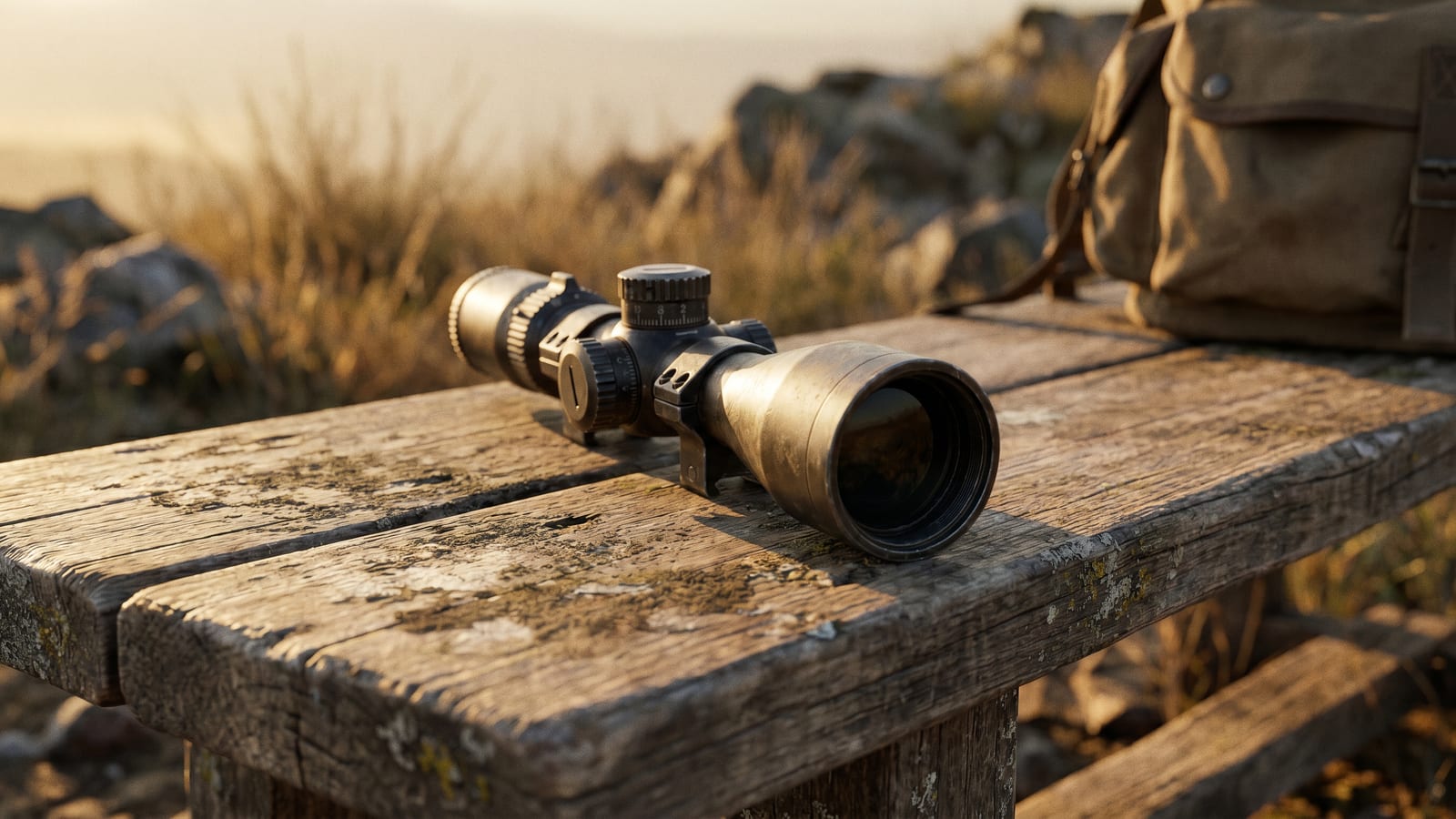
Shoot a rifle scope from slightly off-center and watch your point of impact drift. That is parallax, and it costs you accuracy whether you are plinking at the range or stacking rounds on a deer at 300 yards. Understanding what causes it, where it lives in your optic, and how to deal with it will make you a better shot.
What Parallax Actually Is
Parallax is a mismatch between the reticle plane and the target image plane inside a scope. When your eye moves off-center behind the ocular lens, the reticle appears to shift relative to the target image. The reticle has not moved. The target image has. That apparent shift is parallax, and it means your point of aim no longer matches your point of impact.
The mechanics are straightforward. A scope focuses light from the target onto a specific focal plane inside the tube. The reticle sits on its own focal plane. When those two planes do not coincide precisely with your eye position, you get the shift. This is not a defect in your optic. It is an optical reality that every scope has to manage.
The measurement is yards. A scope set to 100 yards will have minimal parallax at that range. Move to 50 yards or 500 yards and the mismatch grows. Some scopes manage it well enough that you will never notice in the field. Others throw noticeable error at non-designated distances.
Why It Matters for Accuracy
Parallax error compounds with distance and target size. At 100 yards on a paper target, a half-inch of reticle shift does not look catastrophic. At 400 yards on a coyote-sized target, it puts you off-target. The practical consequence is this: a scope with uncorrected parallax forces you to center your eye precisely behind the optic every single shot. One poorly placed cheek weld and your zero is wrong.
For competition and precision shooting this is unacceptable. For hunting it is the difference between a clean hit and a wounded animal. Even small parallax errors at extended range add up to inches of drift, and inches at distance kill less cleanly than you want.
Fixed-parallax scopes (most hunting optics) sidestep the problem by setting the target plane at a fixed distance, usually 100 yards. As long as you are shooting at or near that range, the error is negligible. The trade-off is that these scopes introduce more noticeable parallax shift when you shoot significantly closer or farther than the design distance.
Side Focus and Adjustable Parallax
Rifle scopes with adjustable parallax have a side focus knob or rear adjustment that moves one of the internal optical elements until the target image lands precisely on the reticle plane. When you dial the adjustment to match your actual distance, the mismatch disappears. Move your eye around behind the scope and the reticle stays locked on target. That is a properly parallax-corrected view.
Adjustment ranges vary. A typical hunting scope with adjustable parallax might go from 50 yards to 300 or 400 yards. Dedicated precision scopes push to 1,000 yards and beyond. The adjustment itself is tactile and usually marked in yard increments. On some optics the knob is analog and you estimate. On higher-end models you get a numbered turret that lets you dial exactly.
The practical workflow is simple: range your target, dial the parallax knob to match, verify by moving your eye side to side while watching the reticle. If it stays put on target, you are corrected. If it shifts, dial again until it locks.
Parallax at the Eyebox
Eye relief and eyebox are related to parallax but not the same thing. Eye relief is the distance your eye can be from the scope and still see a full picture. The eyebox is the three-dimensional area behind the scope where that full picture remains visible.
Parallax affects how precisely you must position your eye within that eyebox. A scope with heavy parallax forces you to the exact center of the eyebox every shot. A well-corrected scope lets your eye float within the eyebox without point-of-impact shift. For fast shooting and variable positions, this matters.
Hunting scopes typically have a generous eyebox to accommodate shooting from awkward positions (upward angle, off-hand, unconventional rests). The trade-off is that their parallax correction is limited. Precision scopes push correction to extreme distances but often have a tighter eyebox, which is acceptable because you are shooting from a stable position where eye placement is controlled.
What Distance to Set Fixed-Parallax Scopes
If your hunting scope has a fixed parallax setting, the manufacturer chose a distance based on typical use. Most fixed-parallax hunting scopes are set between 100 and 150 yards. Some are set at the infinity focus point, which actually creates slight parallax at closer ranges.
For general big-game hunting, 100 yards is the right setting. Most shots occur between 50 and 300 yards, and 100 yards splits the error most evenly across that range. The closer you get to the set distance, the less error you see.
If you are shooting primarily at longer distances, 200-yard fixed parallax makes more sense. You will notice slight error on close shots under 50 yards, but your zero holds better at extended range.
A specific case: rimfire scopes. These are often set to 50 or 60 yards because the optic is designed for close-to-mid-range work. Putting a 50-yard fixed scope on a rifle you plan to shoot at 200 yards will cost you precision at distance.
Quick Test: Is Your Scope Paralyzing You?
You can check for parallax error in about two minutes at the range.
- Set up a solid rest. Take a aimed shot at a target and note where it hits.
- Shift your eye to the far left edge of the eyebox without moving your head. Watch the reticle relative to the target.
- Shift to the far right edge. Again note reticle position.
- If the reticle appears to move across the target between those positions, you have parallax error.
To correct it, adjust your scope if it has a parallax knob and repeat the test. If it does not have an adjustment, accept that you need to place your eye consistently in the center of the eyebox for best accuracy.
Adjustable vs. Fixed: Our Take
For most hunters, a fixed-parallax scope at 100 yards is the right call. The error across typical hunting distances is small enough that consistent cheek weld handles it. You do not need a $1,500 tactical optic with a side focus knob to shoot well at deer distances.
That said, if you regularly shoot past 300 yards or you run a precision rifle for varmints, the adjustable parallax knob is worth the cost and the extra control. dialing your scope to match your target distance removes one variable from your shot process. At 500 yards, removing even a small source of error compounds your overall precision.
For competition shooters, adjustable parallax is not optional. The game at that level is removing every source of error you can. Parallax correction is table stakes.
Bottom Line
Parallax is not mysterious or complicated once you understand what is happening optically. Your scope is trying to put the reticle and the target image on the same plane. When it misses, your point of aim drifts. Adjustable parallax knobs fix the mismatch directly. Fixed parallax scopes manage it by locking in a single distance and keeping your shooting within that range.
Know what your scope is set to. Test it at the range. And if you are shooting long distances with a fixed-parallax optic, be honest about the error you are accepting. It is there whether you notice it or not.